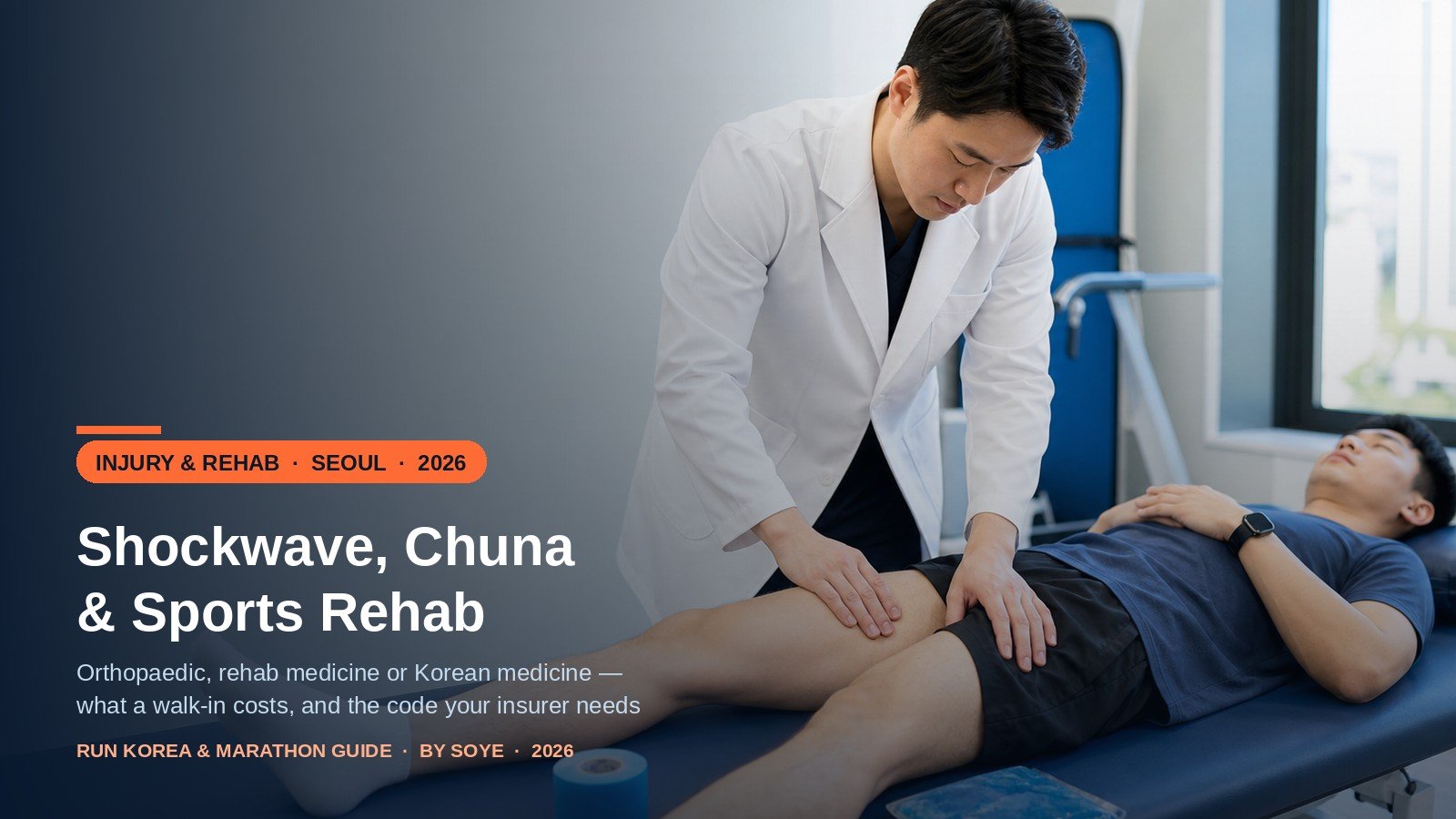
The knee starts talking at kilometre eight, on the flat between Banpo and the Dongjak bridge. You fly home in four days, or you race the JTBC Seoul Marathon in three weeks, and you have no Korean insurance, no Korean phone number and no idea whether a clinic will see you today — so you search in English, find a polished Gangnam practice, and pay two to three times what the same treatment costs four subway stops away. This Seoul runner injury clinic guide is the route I would take instead.
It is built from Korea’s published 2026 fee data, the insurance rules that changed on 1 July 2026, and price lists Seoul clinics now post openly. Three injuries stop most foreign runners — heel, outside knee, the spot under the kneecap — and each has a door, a price and a piece of paper attached. If the pain came with a cold snap, the sub-zero extremity gear guide explains why stiff calves change your stride before you feel anything.
The 2026 fee reset and the insurance change: A neighbourhood orthopaedic clinic in Seoul will see you the same day with a passport, and the exam plus X-ray runs ₩30,000–₩50,000; focused shockwave is worth paying for on plantar fasciitis, and Korea’s insurance rules changed on 1 July 2026. An English-speaking Gangnam clinic is for documents, not for a first diagnosis.
Quick Verdict
Walk into a neighbourhood orthopaedic clinic (정형외과) the same day, with your passport, and expect 30,000–50,000 won for the exam plus X-ray. Pay for focused shockwave only for plantar fasciitis. Use an English-speaking Gangnam clinic for documents, not for the first diagnosis.
In This Guide
- Three Injuries, Three Bedside Tests
- Three Doors: Orthopaedic, Rehab, Korean Medicine
- Table 1: Shockwave vs Manual Therapy vs Chuna
- The 2026 Price Reset
- Chuna and Acupuncture: The Evidence
- Table 2: Injury, Code and Documents
- The Five-Step Clinic Visit
- Documents Your Insurer Will Accept
- The First 72 Hours
- Frequently Asked Questions
Three Injuries, Three Bedside Tests
Population numbers are nearly useless for one person: a review of long-distance runners found lower-limb injury incidence from 19.4 % to 79.3 %, with the knee commonest at 7.2 % to 50 %. Iliotibial band syndrome alone is an estimated 5 % to 14 % of running injuries and the leading cause of lateral knee pain in runners.
Three tests separate the rest. Plantar heel pain is worst on the first steps out of bed, hurts when you press the inside of the heel, and eases after ten minutes of walking. Iliotibial band pain sits on the outside of the knee at a repeatable distance or on downhills, and vanishes when you walk — which is why runners keep running on it. Patellar tendon pain is a pinpoint ache below the kneecap, worst the morning after loading.
Two mimics change the plan. Shin pain spread over centimetres of the inner tibia is usually medial tibial stress syndrome; the same pain in one fingertip-sized spot, worse at night or on hopping, needs imaging to exclude a stress fracture. A knee that swells within hours, locks or gives way is not a tendon problem. Frozen pavements change your stride quietly too — the outsole and grip guide covers the shoe side, but the load lands in the clinic.
Whenever a visitor’s knee starts talking at kilometre eight, I send them to a neighbourhood 정형외과 with their passport, not to the polished clinic near their hotel. The exam and X-ray are ₩30,000–₩50,000 on the same day, and the diagnosis is one doctor’s opinion either way — the Gangnam practice is selling a document for your insurer.
The three bedside tests are worth knowing before you go, because they decide which door you walk through. Heel pain worst on the first steps out of bed, outside-knee pain at a repeatable distance, and a pinpoint ache below the kneecap are three different injuries — knowing which one you have is what stops a ₩400,000 package being sold for a problem that needed an insert.
Three Doors: Orthopaedic, Rehab, Korean Medicine
Korea splits musculoskeletal care across three clinics that are not interchangeable. A 정형외과 is staffed by a board-certified orthopaedic surgeon: here you exclude a fracture, get imaging on site, and receive injections or shockwave. A 재활의학과 is staffed by a physiatrist and built around function — gait analysis, graded loading, the exercise prescription that fixes tendinopathy. A 한의원 is staffed by a doctor of Korean medicine: chuna, acupuncture, pharmacopuncture, herbs.
For a new, focal, load-related pain the orthopaedic door comes first, because diagnosis is the bottleneck and only that door rules out bone. Move to rehabilitation medicine once the diagnosis is clear. Korean medicine suits chronic, diffuse pain with normal imaging.
Sports medicine clusters in Gangnam and Sinsa; Yongsan, Itaewon, Hannam and Myeongdong hold most English-first practices; Hongdae and Mapo are cheaper with less English. Three that publish English terms, listed because they are checkable rather than best: Seoul Jungseok Orthopedic Clinic at Yeoksam Station Exit 3 (walk-ins welcome, weekdays 09:30–19:30, Saturday to 13:00), Relief Orthopedics near Euljiro 1-ga with two English-speaking surgeons, and Jaseng Hospital of Korean Medicine at 536 Gangnam-daero.
Then check what Korean patients never think about: whether the clinic is registered to treat foreign patients. Registration has been mandatory since 2009, registered clinics must carry liability insurance, and the list is public at Medical Korea. If language is what keeps you from a cheaper local clinic, call 1330 — free 24-hour interpretation in English, Japanese, Chinese and Russian — and ask them to interpret at the desk.
Table 1: Shockwave vs Manual Therapy vs Chuna
2026 Korean figures. The coverage column is what foreign runners get wrong.
| Treatment | How it works | Best target | Price per session | Course | Covered? |
|---|---|---|---|---|---|
| Shockwave, radial | Low-energy waves spread wide | Trigger points, calf tightness, early tendon pain | 30,000–80,000 locally; 100,000–240,000 at a Gangnam English clinic | 3–5 weekly, 2,000–4,000 shocks | No, for anyone |
| Shockwave, focused | High-energy waves converged deep | Plantar fasciitis, Achilles and patellar tendons | 80,000–150,000 typical; median 80,000, range top 319,000 | 3–5 sessions, 1,500–3,000 shocks | No, for anyone |
| Manual therapy (도수치료) | Hands-on mobilisation plus exercise | Stiff joints, post-injury range loss, back | 43,850 fixed, 41,658 insured; uninsured median 100,000 | Twice weekly, 15 a year | NHIS members only |
| Chuna (추나) and acupuncture | Manipulation, then needling | Chronic back and pelvic pain, clean X-ray | Simple chuna 25,000; complex 40,000; needling 15,000–25,000 | 2–3 weekly for 2–4 weeks | Chuna insured, 20 a year |
The 2026 Price Reset
Any English guide written before mid-2026 has the wrong manual-therapy prices. On 1 July 2026 Korea made manual therapy a “managed benefit”: a fixed 43,850 won per session at every institution, a 95 % patient share (41,658 won), capped at twice a week and 15 sessions a year, 24 only after surgery or fracture stiffness. Clinics previously averaged about 110,000 won (health ministry announcement).
Good news if you hold an alien registration card and national insurance; nothing at all if you do not. A visitor pays the clinic’s own price, still centred on 100,000 won publicly.
Shockwave went the other way: in December 2025 the government picked manual therapy, epidural blocks and radiation heat as its first managed-benefit items and deferred shockwave. It stays fully uninsured. Health Insurance Review and Assessment Service figures show a hospital-level median of 75,000–80,000 won and published fees from 5,000 to 319,000 for the same item — a spread reflecting shock count, radial versus focused, and whether a specialist performs it.
Chuna has been insured since 2019 for up to 20 sessions a person a year with a 50 % copayment, and the limit follows you between clinics. Non-covered patients pay the published rate: a Seoul median of 25,000 won simple, 40,000 complex, before pharmacopuncture (median 10,000 a point) and herbs. Those add-ons turn a 40,000 won visit into a 150,000 won one.
The English-language premium is measurable. A shockwave session posted at 60,000–120,000 won at one English-speaking pain clinic lists at 100,000–240,000 in Gangnam, and up to 200,000–500,000 in Hannam — legal since the 2009 medical-tourism law let hospitals bill foreigners their own rates. Prices must be posted in the building and online, so photograph the list and compare it on the HIRA non-covered price lookup.
A realistic first visit: consultation 30,000–50,000 won, X-ray 10,000–20,000 per area, ultrasound 30,000–50,000. MRI is where a bill jumps — ask whether it will change the treatment, because for most tendon pain it will not.
Chuna and Acupuncture: The Evidence
Korean medicine is dismissed too fast in English running forums and oversold in Korean brochures. A 2023 meta-analysis of 15 randomised trials with 1,390 patients found tuina, chuna’s parent technique, reduced chronic low back pain (standardised mean difference −0.82) and improved function (−0.91) without serious adverse events — graded low certainty because the trials were unblinded and small. For chronic non-specific pain that is a fair basis for trying it; for a torn tendon it is not a substitute for imaging. Acupuncture rests on better ground: the largest individual-patient meta-analysis, over 20,000 chronic-pain patients, found it superior to sham needling with effects persisting at 12 months. Needling alone runs 15,000–25,000 won.
Two safety points English guides skip. Needling over the chest wall carries a small documented risk of pneumothorax, so ask for shallow needling in the upper back. Deep manipulation is wrong over an acutely inflamed joint, a suspected fracture, or a disc herniation with progressive weakness.
Table 2: Injury, Code and Documents
Insurers ask for the code and Korean clinics write it on the certificate. These are KCD codes, which follow international ICD-10.
| Injury | What confirms it | First-line treatment | KCD | Documents to request |
|---|---|---|---|---|
| Plantar fasciitis | Medial heel tenderness, pain on toe extension | Loading plus focused shockwave | M72.2 | English certificate with code, itemised receipt, session plan |
| Iliotibial band syndrome | Pain 2–3 cm above the lateral joint line | Load management, hip abductor work; shockwave second line | M76.3 | Certificate, receipt, running-restriction period |
| Patellar tendinopathy | Pinpoint tenderness below the kneecap | Progressive loading; shockwave after three months | M76.5 | Certificate, receipt, written exercise programme |
| Achilles tendinopathy | Thickened tendon 2–6 cm above the heel | Calf loading; shockwave for chronic cases | M76.6 | Certificate; urgent referral if rupture suspected |
| Shin pain (MTSS) | Diffuse tenderness over 5 cm of the tibia | Load reduction, cadence change, shoe review | M76.8 | Certificate plus imaging report |
One coding trap if your insurer uses American ICD-10-CM: from 1 October 2026 US coding gave plantar fasciitis its own code, M67.A0-, leaving M72.2 for plantar fibromatosis. Korean clinics still write M72.2, so send both with one line of explanation — it is the commonest reason a heel-pain claim gets queried.
The Five-Step Clinic Visit
A first visit with an X-ray takes about 40 minutes.
- Pick the door and check the clock. Orthopaedic for a new focal pain, rehabilitation medicine if you already have a diagnosis, Korean medicine if it is chronic and imaging is clean. Weekdays 09:00–19:00 with a lunch break near 13:00, Saturday to 13:00, closed Sunday.
- Bring three things, say three sentences. Passport or ARC, insurance card, medication list. Then: “I am a runner. The pain started on this date, here. It is worse when I do this.”
- Register, then ask the price. Give your name exactly as printed in the passport. Before any test ask 비급여 얼마예요? and ask to see the posted list. Sign the non-covered consent form only for items you have seen priced.
- Get examined and imaged on site. Expect history, palpation, a squat or hop test and an X-ray in the same building. Ask what the working diagnosis is, and what code will go on the certificate.
- Choose with three questions, collect documents the same day. Does it change the diagnosis, what is the evidence, what happens if you wait two weeks? Then take the English certificate, itemised receipt and images before you leave.
- Passport, ARC if you have one, policy number on your phone
- Onset date and the distance or surface that triggers the pain
- Current medications, including blood thinners and NSAIDs
- Non-covered price list photographed before consent
- Working diagnosis and KCD code written down
- English certificate ordered at check-in, not checkout
- Itemised receipt in English — free at nearly every clinic
- X-ray or ultrasound images as a file or CD
Documents Your Insurer Will Accept
The standard set is cheap. The English general medical certificate has a legal ceiling of 20,000 won; the itemised receipt is free; record copies cost 1,000 won a page for the first five pages; an X-ray CD runs about 10,000. A clinic quoting 100,000 won is selling an injury certificate or custom form the ceiling does not cover.
Ask for four things: the diagnosis in English with the KCD code, the date symptoms began, a line saying the problem is running-related, and the plan with sessions and expected recovery. Insurers reject claims less for the amount than the wording: “knee pain” is not a diagnosis, but “iliotibial band syndrome, M76.3, onset 14 November 2026, running-related, return to running in four weeks” is.
Then attach what your policy lists — certificate, itemised bill, payment confirmation, passport copy, claim form — inside the 30-day window most policies set. If treatment continues after you fly home, take the record with you.
The First 72 Hours
RICE has been replaced by PEACE & LOVE, published in the British Journal of Sports Medicine in 2019. For one to three days: Protect with relative rest, Elevate, Avoid anti-inflammatories and ice as a routine because early inflammation is part of healing, Compress swelling, Educate yourself on the timeline. Then Load progressively, stay Optimistic, keep Vascularisation with pain-free cardio, Exercise — the loading is the treatment.
That anti-inflammatory line needs care where the pharmacy is the first stop. For a flare that stops you sleeping, a short course of ibuprofen 200 mg, naproxen 250 mg or acetaminophen is reasonable; painkillers taken so you can keep training a tendon are not. Topical diclofenac patches (7 for around 2,200–3,000 won) suit heel and knee pain. What else is sold over the counter, and how late Seoul’s pharmacies stay open, is in the Korea pharmacy and contrast-bath guide.
Taping is where visitors overpay. Daiso sells a 2.5 cm × 3 m sports roll for 1,000 won and a reusable hot-or-cold pack for 3,000; a pharmacy charges 8,000–15,000 for a branded roll. Tape supports and reminds; evidence that kinesiology tape changes healing is weak. Protein in the 24 hours after a long run does more — the high-protein recovery meal guide lists what to order near the river parks, and the Banpo and Jamsugyo route guide has the exits and lockers for the limping walk back.
And know the line between a clinic and a hospital. Go to an emergency department, 119, if you cannot take four steps, if the limb is deformed, if a joint is hot and you have a fever, if pain is severe at rest, if the calf is swollen after a long flight, or if a foot drags. Uninsured patients pay the hospital’s own rates in full there, so call your insurer’s assistance line before admission, not after.
Frequently Asked Questions
Can I walk into a Korean orthopaedic clinic without an appointment?
Yes. Walk-in registration is the default and English-first practices advertise it. Arrive before the lunch break near 13:00 and before last check-in, usually 30–60 minutes before closing; Saturday closes around 13:00 and Sunday is shut.
Do I need an alien registration card, or is my passport enough?
A passport is enough to register and to have documents issued in your name. An ARC matters only for national health insurance, which residents get and short-term visitors do not.
What will one visit cost without Korean insurance?
Budget 30,000–50,000 won for the consultation, 10,000–20,000 for an X-ray, 30,000–50,000 if ultrasound is used. At a premium Gangnam clinic the same visit reaches 150,000 before any procedure.
Is shockwave therapy worth it for plantar fasciitis?
Yes — the one indication where evidence is strong. A 2023 meta-analysis graded plantar fasciitis outcomes as moderate to high certainty with large effects versus placebo, and a 2024 review found it beat steroid injections at three and six months. For patellar and Achilles tendons the effect was negligible.
Should I see a Korean medicine clinic for a running injury?
For chronic back, hip or diffuse pain with normal imaging, it is reasonable: tuina and chuna show benefit for low back pain at low certainty. For an acute tendon or bone injury, get imaging first, and ask for the itemised cost — pharmacopuncture and herbs usually cost more than the manipulation.
Will my travel insurance cover treatment in Seoul?
Usually, if the policy covers sport and the treatment is medically necessary rather than ongoing. You pay at the clinic and claim afterwards; Korean clinics do not bill foreign insurers directly. Ask for the coded English certificate, the itemised receipt and the record.
Can I keep running while I am being treated?
Often yes at reduced load — complete rest rarely fixes tendinopathy. The test is pain at or below 3 out of 10 that settles within 24 hours. If it climbs, changes your gait, or is worse next morning, the load comes down.
Final Summary
Door: a neighbourhood orthopaedic clinic on the day of pain; rehabilitation medicine once the diagnosis is clear; Korean medicine only for chronic, diffuse pain with clean imaging.
Price: consultation 30,000–50,000 won, X-ray 10,000–20,000, focused shockwave 80,000–150,000 locally. Manual therapy is a fixed 43,850 won for insured residents, about 100,000 self-pay for visitors.
Documents: English certificate capped at 20,000 won, itemised receipt free, records 1,000 a page. Ask for the KCD code — M72.2 heel, M76.3 outside knee, M76.5 patellar tendon.
Emergency: cannot bear weight, deformity, fever with a hot joint, a swollen calf, a foot that drags. Call 119.
Medical disclaimer. General information for healthy adult runners, not medical advice or a recommendation of any clinic. Prices are published 2026 Korean figures and vary by institution; insurance rules differ for residents and visitors. Get assessed for any injury that stops you running, and call 119 in an emergency.
Sources: HIRA non-covered price disclosure and lookup (hira.or.kr); Ministry of Health and Welfare, manual-therapy managed benefit effective 1 July 2026 (korea.kr), managed-benefit items selected 9 December 2025, and notice 2021-34 on certificate fees; Medical Korea registered-hospital lookup (medicalkorea.or.kr); van Gent et al., Br J Sports Med 2007; van der Worp et al., Sports Med 2012; Charles et al., Front Immunol 2023; Cortés-Pérez et al., Clin Rehabil 2024; Yang et al., Medicine 2023; Dubois & Esculier, Br J Sports Med 2019. Prices checked 18 November 2026 at Seoul Jungseok Orthopedic Clinic, Yonsei Shinmyung Pain Clinic, Seoul Nasol Pain Clinic and Daiso Mall.