Tomorrow morning the Han River path gets its first honest test of the season. Seoul’s overnight low drops to −2 °C on Thursday, then −5 °C by Saturday, with daytime highs of 2 to 4 °C and a north-west wind at 15 to 20 km/h along the water. Your legs will be fine by the second kilometre. Your fingers, toes and ear tips will not be fine at any point, because they never warm up the way a working muscle does.
That asymmetry is where most winter gear advice goes wrong. It says buy merino because merino is warm when wet, toe socks because they stop blisters, a neck gaiter because cold air hurts your lungs. Each is a half-truth pointing at the wrong purchase. This guide uses measurements: the KMA’s wind chill table, thermal-chamber trials on gloves and mittens, and the blister literature that keeps failing to confirm what the sock aisle promises.
What −3°C does to fingers and toes: Korea’s wind chill follows the JAG/TI formula the KMA publishes, valid at or below 10°C with wind of at least 1.3 m/s; on the Han River path a −5°C air temperature with a 4–5 m/s wind reads far colder, and the forecast has Seoul at −2°C overnight on Thursday, −5°C by Saturday, with 2–4°C highs and a 15–20 km/h north-west wind along the water. Fingers, toes and ear tips never warm up the way a working muscle does.
Quick Verdict
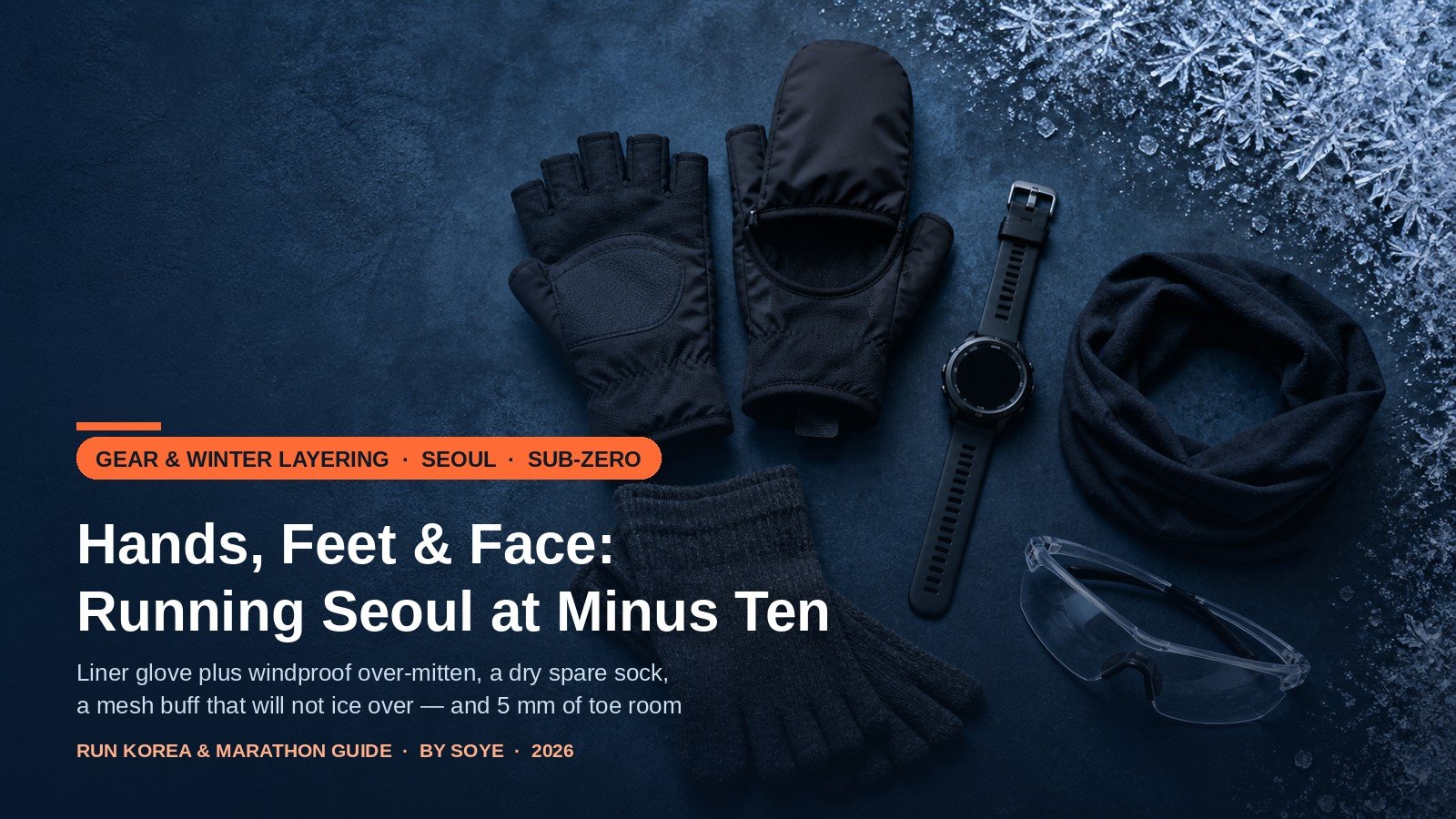
Buy a two-piece hand system — a thin liner glove plus a windproof over-mitten — not one bulky glove. Carry a dry spare sock. Cover your mouth with a mesh or double-layer buff, your ears with anything at all, and leave 5 mm of room in the toe box.
In This Guide
- The Cold Math: What −3 °C Actually Feels Like on the Han
- Hands: Why the Flip Mitten Is Only Half a System
- Feet: The Sock Material Is Not the Variable You Think
- Face and Airway: A Buff Is a Device, Not a Scarf
- Body-Part Gear Comparison
- 0 °C to −15 °C: What Actually Changes
- Buying It in Seoul This Week
- The Eight-Step Sub-Zero Routine
- Frequently Asked Questions
The Cold Math: What −3 °C Actually Feels Like on the Han
Korea’s wind chill follows the JAG/TI formula, and the KMA publishes the equation and a lookup table. Wind enters at 10 metres above ground, in km/h, and the formula is valid at or below 10 °C with wind of at least 1.3 m/s. That height matters on a river path, though on an embankment with nothing upwind for 800 metres, forecast wind and chest-level wind are close enough to plan around.
Read the table for a January dawn. At −5 °C air, a 4.2 m/s wind gives a wind chill of −11 °C and 6.9 m/s gives −12 °C. At −10 °C air the same winds give −17 °C and −19 °C; at 8.3 m/s with −15 °C air, −26 °C. A calm morning and a windy one differ by about six degrees of felt cold on the same thermometer.
One correction to the figure that circulates in Korean running blogs: −3 °C with a 4 to 7 m/s wind does not feel like −12 °C. On the KMA equation it is about −8 °C at 4 m/s and −10 °C at 7 m/s. The scare number comes from putting metres per second where kilometres per hour belong.
The frostbite line nobody quotes. The US National Weather Service states plainly that wind chill cannot freeze skin while the actual air temperature is above 0 °C — only hypothermia is a risk then. At +2 °C on the Han you are not getting frostbite; you are getting clumsy, numb hands that cannot open a gel packet. Frostbite begins when the air is below zero and wind chill reaches the KMA’s 경고 band of −45 to −25 °C, where exposed skin can freeze in 10 to 15 minutes. Between −10 and −25 °C the band is 주의: long unprotected exposure is a hypothermia risk, not immediate freezing.
Why extremities lose first is simple plumbing: peripheral vessels constrict to protect the core, so flow to fingers, toes, ears and nose falls sharply, and those parts hold heat badly — large surface area, little mass, almost no insulating fat. A calf generates heat with every stride; a little finger has nothing to generate. Treat hands, feet and face as a separate system from your torso.

Whenever the river forecast goes below zero, I pack a liner glove under a windproof over-mitten, and a dry spare sock. One bulky glove is half a system — your fingers are warm for twenty minutes and then the sweat inside does the rest — and a dry sock at the locker is the difference between a good run and a cold ride home.
The face is a device question, not a scarf question. A mesh or double-layer buff warms the air before it reaches your airway, and anything over the ears beats a hat you take off at kilometre three. I also leave 5 mm of room in the toe box: cold foam firms up, so the shoe that fits in October pinches in January.
Hands: Why the Flip Mitten Is Only Half a System
The case for mittens is a thermal-chamber result. Gloves and mittens of comparable build hung in −10 °C air at 0.7 m/s for 30 minutes: inside the mittens the finger-area mean sat at 34.0 °C with a 33.6 °C minimum, inside the gloves 29.7 °C mean and 26.3 °C minimum. Fingers pressed together share one warm air pocket rather than five thin ones, and one outer surface needs warming instead of five.
Thin insulation costs you whatever the shape. Walking 90 minutes at −30.6 °C, subjects in wind-blocking fleece gloves (0.95 clo) saw little-finger temperature fall to 7.9 °C; in thick ski mittens (1.46 clo) it held at 17.8 °C. A finger stays near a comfortable 33 °C only when glove insulation roughly equals whole-body ensemble insulation, which no running glove approaches. The answer is not one better glove but two layers you can adjust.
The gap worth knowing before you spend: Decathlon’s KIPRUN Evolutive V2, 57 g in size L, with an aluminium-lined cover that stows in the wrist, is officially rated 6 to 11 °C as a glove and 0 to 6 °C with the cover on. It is the right buy for Seoul’s November and it is rated to freezing, not −10 °C; no mainstream running brand publishes a rating below zero. The Kobe trial tested the missing half: a windproof over-mitten over a glove lifted finger mean temperature 4.4 % and the minimum 7.6 % at −10 °C — small percentages that separate hands that work from hands that fumble.
So wear a thin conductive liner under it, sized so the shell never compresses the liner, and strip in order: over-mitten off at 8 to 10 minutes, liner kept to the last kilometre, never both at once below −5 °C.
Two details decide whether this works. Never blow warm air into gloves: the vapour condenses and freezes, and you trade five minutes of comfort for a stiff glove. And when fingers go numb, windmill the arm from the shoulder for 20 seconds — centrifugal force moves blood back into the hand faster than any trick on the move.
Feet: The Sock Material Is Not the Variable You Think
Everyone in Korea repeats that cotton socks become an ice pack. The evidence says something more useful: the problem is water, not cotton. A 2022 study of 203 long-distance hikers found wet socks raised blister risk 1.94 times (95 % CI 1.04–3.61), while the share of natural versus synthetic fibre had no relationship to blisters. Wet is the variable; fibre is mostly the marketing.
Fibre is not irrelevant everywhere. In padded socks of identical construction, the all-cotton group developed twice as many blisters and blisters three times larger than the acrylic group, because cotton holds water against the skin. Notice what won: densely padded acrylic, not luxury merino. The 2023 review in the Journal of Athletic Training found supporting evidence for padded acrylic socks, neoprene insoles and familiarity with your own shoes; powder and antiperspirant were non-protective.
Then the uncomfortable part for toe-sock believers. The same review examined toe socks and concluded their effectiveness has not been established. In the closest trial, runners using paper tape plus Injinji toe socks blistered more often than the comparison group — 34 % of those feet against 27 %. The mechanism is real: toes separated by fabric cannot rub each other. The evidence it prevents blisters, in a shoe whose toe box may be too narrow for the extra bulk, is not there yet.
- Pick socks you can change, and carry a dry pair to the finish. Two thin, densely knit pairs beat one thick one, and the wet sock is the coldest thing you own once heat production falls.
- Want toe socks? Size the shoe to them. Try them in the shoe you will race in, at the end of the day; if the toe box touches, the sock creates pressure instead of relieving it.
- Merino is comfort, not heating. A 200 g merino top absorbs about 86 % of its weight in water against polyester’s 54 %, and drying that costs 389 kJ against 241 kJ. In a cycling trial at 8 °C the two performed similarly. Wool feels dry against skin up to about 30 % moisture — worth paying for; “warm even when wet” is the part that fails.
The shoe-fit number to remember is 5 mm. A winter sock adds volume everywhere, and a shoe that fit in October now presses across the toes and instep. Pressure cuts circulation, which means cold feet whatever the sock — and cold plus pressure is the blister recipe. If your toes touch the front, go up half a size or drop to a thinner sock, and loosen the forefoot lacing only, keeping the midfoot locked, or your foot slides forward on descents. On icy sections you will be walking, and walking in a wet sock is worse than running in one; the outsole grip guide for icy Seoul pavements explains why no rubber compound grips ice.
Face and Airway: A Buff Is a Device, Not a Scarf
Breathing cold, dry air hard is a measurable stress: it cools and dries the airway, triggers bronchoconstriction in susceptible runners, and leaves a cough that lingers an hour. The fix is a heat-and-moisture exchange surface, and the trials are clear. With −13 °C air, a real exchange mask raised inspired air to 19 °C where a dummy reached 10 °C, and the post-exercise fall in FEV1 was 10 % against 22 %; a 2018 cycling trial at 8 °C found 6 % against 13 %.
Anything that traps a pocket of warm exhaled air works, and thicker is better until it ices over — which a single-layer fleece gaiter does by kilometre six, leaving you breathing through a frozen slab. Take a double-layer buff with a mesh panel that vents enough moisture to resist icing, or two thin buffs rotated at halfway, or the buff below the nose for intervals, or nothing while breathing through the nose at easy pace.
Ears hurt first and hardest: thin cartilage, no insulating fat, and among the tissue the NWS chart counts first to freeze. A headband is the running answer — ears covered, heat leaving the crown. A beanie is correct below about −10 °C, when scalp heat loss outweighs the sweat it traps; Daiso sells knit-and-fur earmuffs for 2,000 won and folding padded ones for 3,000 won. Add thin clear sport glasses, for wind rather than sun: at 20 km/h, watering eyes blur your line on a path shared with cyclists.
Body-Part Gear Comparison
What fails first, what structure helps, and what to buy in Seoul. Wind resistance is a property of the garment, not a temperature claim.
| Body part | What fails first | Structure that works | Wind resistance | Breathability | Seoul pick |
|---|---|---|---|---|---|
| Hands | Finger dexterity, then sensation; gel packets become impossible | Thin liner plus separate windproof over-mitten, adjustable | High — the shell is the point | Liner breathes; shell need not | KIPRUN touchscreen liner (6–11 °C) plus an aluminium-lined flip cover or over-mitten |
| Feet | Wet fabric on skin, then pressure in a tight toe box | Thin densely knit sock, spare pair, +5 mm toe room | Low priority — the shoe blocks wind | Moderate; dry matters more than breathable | Two pairs of padded acrylic or wool-blend crew socks; toe socks only if the shoe allows the volume |
| Ears | Pain within minutes; thin cartilage, no fat | Headband at 0 to −8 °C; beanie below −10 °C | Medium — wind is the whole problem | Headband vents; beanie does not | Any running headband; Daiso earmuffs at 2,000–3,000 won as the emergency layer |
| Face & airway | Dry cough and bronchoconstriction; watering eyes | Two thin buffs or a mesh-panel buff; clear glasses | Medium — must vent, not seal | High — mesh or double layer, never single fleece | Two-pack of thin neck gaiters; clear sport glasses |
0 °C to −15 °C: What Actually Changes
Most Seoul winter running happens between 0 and −8 °C, and the differences inside that range are smaller than the internet suggests. What changes with each step down is not glove thickness but whether you have a windproof layer, anything dry to change into, and how much face is exposed.
| Band | Hands | Feet | Face & ears | Body | Watch for |
|---|---|---|---|---|---|
| 5 to 0 °C | Thin liner only; over-mitten in the pocket | Normal socks | Nothing, or a headband at dawn | Long sleeve plus thin wind vest | Overdressing — you freeze at the stop light |
| 0 to −5 °C | Liner plus over-mitten; strip the mitten at 10 minutes | Thicker sock; check toe room | Headband; buff below the chin | Base layer, windproof jacket, tights | Wind chill of −8 to −12 °C on the river; hands numb before you feel cold |
| −5 to −10 °C | Both layers for the first 2 km; warmer on the back of the hand | Wool or padded acrylic; spare pair in the bag | Buff up at easy pace, down for effort; headband or thin beanie | Add a second thin layer; windproof non-negotiable | Icing buff, fogging eyewear, frozen bottles — soft flask inside the jacket |
| Below −10 °C | Two layers plus warmer from the start; no bare-hand phone use | Thick sock, dry spare, wind-blocking sock shell | Beanie, buff up, clear glasses, thin balaclava if windy | Full three-layer system; two buffs | Frostbite window (KMA 주의 band); shorten the loop, skip the exposed bridge |
Layering the torso too? The three-layer rule for sub-zero Seoul running covers that side: the torso system manages sweat, the extremity system manages wind.
Buying It in Seoul This Week
Decathlon is the first stop because it publishes comfort ratings instead of adjectives. The Dongdaemun store (중구 을지로 264, DUNDUN 4th floor, 10:30–21:00 daily) is the most central, and the Cheongnyangni branch opened 23 October 2026 inside Lotte Mall Belly Town with a running-and-hiking focus that suits this list. The touchscreen liner is around 8,000–10,000 won; the flip-cover Evolutive V2 lists near 16,000 won, seen at 14,300 won on discount.
Daiso covers the emergency layer: fur earmuffs 2,000 won, folding padded earmuffs and a 3M fleece-lined neck warmer 3,000 won each — that warmer is the single-layer gaiter that ices over, so buy it for the walk to the start. For running-specific stock and fitting, including shops that let you try a winter sock inside the shoe you will race in, the Seoul winter gear fitting guide lists the specialists and their 2026 terms.
The Eight-Step Sub-Zero Routine
The order I would do things in on a −6 °C morning at Yeouido or Banpo, door to first kilometre.
- Check the wind, not just the temperature. A 4 °C morning at 7 m/s is colder than a −1 °C morning with no wind.
- Dress for ten minutes in, not the doorstep. Warm at the door means soaked at kilometre three.
- Liner gloves first, then over-mittens. Tying your shoes first is how you get numb fingers.
- Buff up, mouth covered, glasses set. The first two minutes are when the cough starts.
- Walk five minutes before running, letting vasoconstriction settle before you load the joints.
- Strip at ten minutes, decisively: over-mittens off, buff to the chin, beanie to headband, stowed one-handedly.
- Windmill one arm for 20 seconds on bridges and open river stretches.
- Change socks and cover your ears within ten minutes of stopping. If you have gone properly cold, the pharmacy and contrast-bath protocol in this post-run recovery guide is the next step.
- Wind speed checked for the actual run hour
- Thin liner plus windproof over-mitten, reachable one-handed
- Spare dry socks in the bag or car
- Sock and shoe tried together with 5 mm of toe room
- Two thin buffs, or one with a mesh panel — not one fleece gaiter
- Ears covered: headband, beanie, or 2,000-won Daiso earmuffs
- Clear glasses on, anti-fog on both sides
- Soft flask inside the jacket, phone in an inner pocket
- Short exit option; no committing bridge below −10 °C
Frequently Asked Questions
Is a flip mitten enough on its own for a Seoul winter?
Not below about −5 °C, and no mainstream brand claims otherwise: Decathlon rates its convertible mitten to 0–6 °C with the cover on. At −10 °C wear a liner underneath and treat the mitten as the shell.
Do I need merino wool socks, or will any warm sock do?
Any sock that stays dry and fits will do. Fibre was unrelated to blisters in a 203-hiker study, while wet socks raised the risk 1.94 times; merino earns its price in comfort and odour control, not heat.
Are toe socks actually better for preventing blisters?
The mechanism is sound, the evidence is not: a 2023 review found toe-sock effectiveness unestablished, and the closest trial found more blistering with them. If you like them, size the shoe to the extra volume.
Should I cover my mouth when running in the cold?
If you cough after cold runs or have asthma, yes — an exchange surface cut the post-exercise fall in lung function from about 22 % to 10 %. Otherwise a buff below the chin and nasal breathing are enough, and a single thick fleece gaiter freezes.
What temperature is too cold to run in Seoul?
There is no single number, but the decision changes below −10 °C, where the KMA 주의 band starts. Below −15 °C with wind, take a shorter loop and skip the exposed bridge. The January mean low is −5.5 °C.
Why do my hands hurt even in good gloves?
The gloves are probably not windproof, and blood flow to the fingers is the first thing the body sacrifices. A windproof shell over a thin liner beats a thicker non-windproof glove.
Final Summary
Hands: two layers, always — a thin touchscreen liner plus a windproof over-mitten. No single running mitten on the Korean market is rated below freezing.
Feet: dry beats merino. Carry a spare sock, leave 5 mm of toe room, and treat toe socks as a fit question rather than a blister cure.
Face: a mesh or double-layer buff softens the cold-air load on your airway; single fleece freezes. Ears need covering below zero — a headband is enough.
This week in Seoul: lows of −2 °C Thursday and −5 °C by Saturday, with 15–20 km/h wind on the Han — a liner-plus-mitten, two-buff, headband week, not a parka week.
Winter running disclaimer. General information for healthy adult runners, not medical advice. Cold-weather exercise carries risks including hypothermia, frostnip and bronchoconstriction. If you have asthma, a heart condition, Raynaud’s or circulatory problems, check with a clinician first. Run with a phone, tell someone your route, and turn back when the KMA wind chill enters the warning band.
Sources: KMA wind chill table and warning bands (data.kma.go.kr); NWS wind chill chart and frostbite guidance (weather.gov); Decathlon Korea ratings and Seoul stores (decathlon.co.kr); Daiso Mall listings; Watanuki et al. and Gao et al. (2016) on hand insulation; Rushton & Richie (J. Athletic Training 2024) and Chicharro-Luna et al. (2022) on blisters; Nisar et al. (1992), Jackson et al. (ERS 2018) and Millqvist et al. (2000) on cold-air breathing; Cernych et al. (2017) on moisture. Last checked 18 November 2026.
1 thought on “Sub-Zero Running in Seoul: Cold Gear for Hands, Feet & Face (2026)”