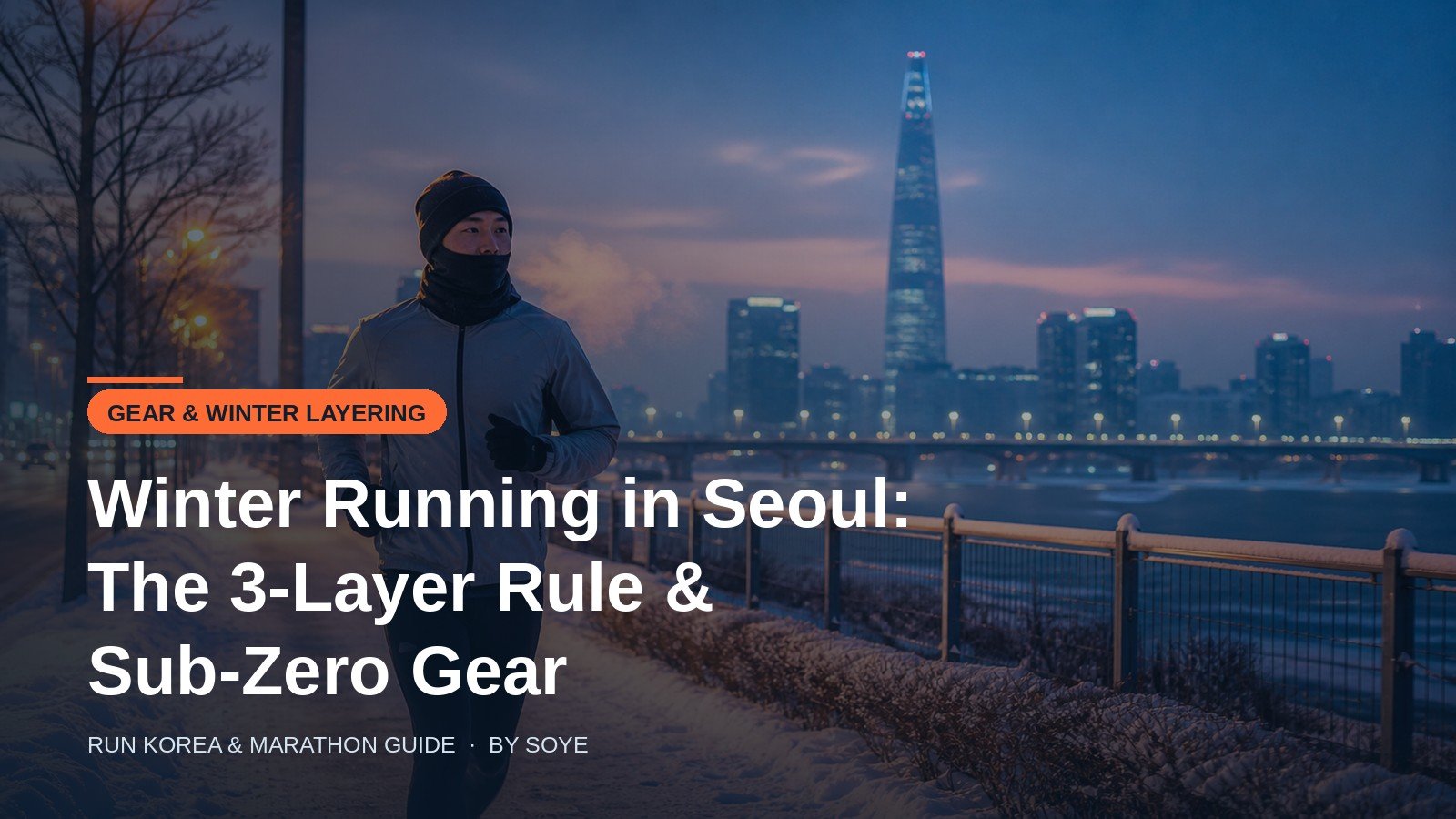
Seoul winter running has a reputation that is only half true. Yes, January mornings here can sit at −10°C with a wind that comes off the frozen river and finds the one gap in your jacket. But the air is dry, the sky is often a hard blue, the paths are empty, and the runners who learn the layering rule stop dreading the season within two weeks. What actually breaks people is not the temperature. It is dressing for the temperature they see on a weather app instead of the one their body will be producing six kilometres later.
This is the system I have used through eight Seoul winters: three layers, a fixed set of extremities, and a pacing adjustment that keeps a cold run from turning into a hard run.
Quick Verdict
Three layers, always: a merino or polyester base, a grid-fleece mid, a thin windproof shell. Below −10°C add a second mid or switch to a heavier base, and never add a waterproof membrane — it traps sweat and you finish colder than you started. Cover the four extremities (ears, neck, hands, ankles) before you add a fourth layer anywhere else. Warm up indoors for 10 minutes, then run 10–20 seconds per kilometre slower than your autumn pace for the first 3 km. And check the particulate reading: Seoul’s worst winter days are an air problem, not a temperature problem.
What a Seoul winter actually feels like
Seoul sits in a cold, dry continental pocket. December to February averages hover around freezing, with January the coldest month, and a handful of Siberian cold snaps each winter that push the morning low to −12°C or below. Snow is modest — a few meaningful falls a season — but the ground stays frozen for weeks, and the wind on the Han River paths is a separate weather system of its own.
| Month | Average low | Average high | What it feels like at 06:30 | Typical kit |
|---|---|---|---|---|
| December | about −5°C | about +3°C | Crisp, dry, gloves needed, ears sting for the first kilometre | Base + mid + light shell |
| January | about −7°C | about +2°C | The real thing: frozen pavers, wind off the river, breath visible for the whole run | Heavy base + mid + shell, mitts |
| February | about −4°C | about +5°C | Cold start, warm finish; the first 09:00 runs of the year feel like spring | Base + mid, shell in the bag |
| Cold snap | −12 to −16°C | −5°C | Skin exposed for 20 minutes is a problem; every layer matters | Double mid, buff over the face, hot pack |
Two local details that visitors do not expect. First, the riverside is 3–5°C colder than the streets — the Han River paths are wide, open and wind-exposed, so the jacket that works in Eunpyeong-gu is not enough at Nanji. Second, Seoul’s coldest mornings are usually the clearest, which is why so many winter runs here come with a blue sky and a photograph you would not believe was −8°C.
The 3-layer rule, and the temperature table
The rule is simple: move moisture (base), trap heat (mid), block wind (shell). Each layer has one job, and the mistake almost everyone makes is asking one layer to do two jobs — a waterproof shell over a cotton T-shirt is the classic, and it produces the coldest possible run.
Start your run feeling slightly cold. If you are warm and comfortable standing outside the door, you are overdressed by one layer, and you will be wet with sweat at kilometre four. The useful test: you should feel comfortable after 10 minutes of running, not before.
| Temperature | Base | Mid | Shell | Extremities |
|---|---|---|---|---|
| +5 to 0°C | Long-sleeve polyester or 150 gsm merino | Optional light fleece | Vest or none | Thin gloves, earband |
| 0 to −5°C | 150–200 gsm merino | Grid fleece, 100–150 gsm | Thin windproof jacket | Gloves, beanie, buff |
| −5 to −10°C | 200 gsm merino, long sleeve + long tights | Grid fleece, 150–200 gsm, half-zip | Windproof shell, taped front panel | Liner + mitten, buff over chin, wool socks |
| −10 to −15°C | Heavy merino 260 gsm or polyester + thin wool vest | Heavy fleece or two mids | Windproof shell plus windproof tights | Mitts over liners, two buffs, hot pack in pocket |
| Below −15°C | Shorten the run, choose a sheltered loop, or take it to a treadmill. This is the band where frostbite on exposed skin becomes realistic. | |||
Layer by layer: what to buy and what to skip
The base layer. Merino, 150–200 gsm, is the best money you will spend: it stays warm when damp and does not hold odour, which matters when you are wearing it four times a week. A polyester base from Uniqlo’s Heattech line or Decathlon’s running range costs a third as much and works well for anything above −5°C. What does not work is cotton, in any weight, at any temperature — it holds sweat against your skin and turns a cold wind into a genuine problem.
The mid layer. A grid fleece (“power grid” fabric with the waffle texture inside) or a light half-zip is the sweet spot: it traps air, dumps heat when you unzip, and dries faster than a puffy. Avoid down and synthetic-filled jackets for running — they are warm when standing and useless once you sweat. If you own only one mid, make it a 150–200 gsm grid fleece with a deep front zip.
The shell. A thin, unlined windproof jacket — nylon or a light softshell — is the third layer. The counter-intuitive part: below about −5°C you do not want a waterproof/breathable membrane. A membrane’s breathability collapses in cold air, so your sweat condenses inside it and you finish the run cold and clammy. Save the rain shell for actual rain; for dry cold, choose the piece that lets the most moisture out and blocks the most wind.
Ears, neck, hands, feet: the four fixes
If you take one thing from this article, take this: the extremities lose the heat war before your torso does. Fixing them is cheaper and more effective than buying a heavier jacket.
- Ears. A thin earband for 0 to −5°C, a beanie below that. A beanie that covers the ears is worth more than an extra torso layer.
- Neck. A tubular buff pulled up over the chin warms the air before you breathe it and keeps the wind off your throat. Below −10°C, wear two and pull one over your nose for the first kilometre.
- Hands. Thin liner gloves plus a windproof mitten shell outperform a single thick glove, because you can take the mitten off at 3 km and keep the liner on. Chemical hand warmers (핫팩) are sold at every convenience store for around ₩1,000–1,500 — one in each pocket, or one inside the mitten on the coldest mornings, is the single most local piece of kit in this guide.
- Feet. Wool or wool-blend socks, midweight. Shoes: a water-resistant upper for slush, and a trail shoe if your route has any unpaved sections. For the two or three genuinely icy mornings each winter, slip-on crampons (아이젠) from Daiso cost a few thousand won and are the difference between a run and a fall.
Pacing, heart rate and breathing in cold air
Cold air changes the arithmetic of a run in three ways, and adjusting for them is what stops winter training from feeling like punishment.
- Warm up indoors, not outdoors. Ten minutes of skipping, lunges, glute bridges and easy movement inside means your first outdoor kilometre starts with warm muscles. Cold muscles strain more, and a cold-weather strain takes longer to heal.
- Run the first 3 km slower — 10 to 20 seconds per kilometre slower below −5°C. Your body is spending energy on heat, blood is being shunted between skin and muscle, and your perceived effort will be higher than your pace suggests. Let the pace come to you at kilometre four.
- Respect the heart-rate drift, not the watch number. In cold air your heart rate at an easy pace is often a few beats lower than in summer heat, which tempts you to push. Effort and breathing are the better guides in winter; if you are breathing hard at a pace that used to be easy, you are working harder than you think.
- Shorten the hard sessions and lengthen the easy ones. Intervals below −10°C are hard on the airways; keep them to 200–400 m reps with full recovery, or move the session indoors. Long runs are fine, but keep them under about 90 minutes in a cold snap and plan the route to pass a convenience store.
- Breathe through the nose and the buff for the first kilometre. It warms and humidifies the air. If you have exercise-induced asthma, treat sub-zero running as a medical decision, not a character test, and carry your inhaler.
Ice, pavers and the Seoul surface problem
Seoul’s sidewalks are paved with small rectangular blocks (보도블록), and after a freeze-thaw cycle the joints between them hold ice in a way that asphalt does not. The dangerous places are consistent: shaded north-facing slopes, bridge decks, the ramps down to the stream paths, and the tile plazas in front of subway entrances. Cheonggyecheon’s stone path is the worst of the scenic routes in winter — beautiful, and genuinely slippery.
What locals do: run the roads and the wider paths rather than the narrow sidewalks, take the stream underpasses slowly, and shorten the stride on anything that looks wet and dark. Fresh snow, counter-intuitively, is fine — it grips. It is the refrozen slush of the third day that puts people in the clinic.
Particulate air: when to run indoors
Seoul’s winter air is the other variable. Cold, stagnant air traps fine dust, and January and February bring the year’s worst readings — the days when the skyline looks like it has been drawn in pencil. Local runners check the AirKorea app (에어코리아) before a hard session, and the honest rule is this: easy running is usually acceptable when PM2.5 is in the “moderate” band, but hard intervals and long runs belong indoors on “bad” days.
The practical routine: check the app at the same time you check the temperature, choose an indoor alternative (a treadmill, a gym, or a swimming pool) if the reading is bad, and do not try to solve it with a mask — the masks that filter fine dust are not designed for the airflow a runner needs, and the ones that are comfortable do not filter enough.
Where to buy winter kit in Seoul (under ₩100,000)
| Item | Where | Price (approx.) | Note |
|---|---|---|---|
| Merino base layer, 200 gsm | Decathlon, Musinsa Standard, Uniqlo | ₩25,000–45,000 | The one place to spend |
| Grid fleece mid, half-zip | Decathlon, Musinsa Standard | ₩25,000–40,000 | Deep front zip matters |
| Windproof shell (unlined) | Decathlon, Nepa, Black Yak outlets | ₩30,000–80,000 | No membrane for dry cold |
| Beanie, earband, buff | Daiso, Uniqlo, any sports shop | ₩1,500–12,000 | Buy two buffs |
| Glove liner + mitten shell | Daiso, Decathlon | ₩3,000–20,000 | Liner under ₩3,000 is fine |
| Wool socks (3 pairs) | Daiso, Uniqlo | ₩3,000–15,000 | Cotton socks will hurt you |
| Hot packs (10 pack) | Any convenience store | ₩10,000–15,000 | The most Korean item here |
| Slip-on crampons (아이젠) | Daiso, online | ₩3,000–12,000 | For icy mornings only |
Total for a complete winter kit, if you buy everything at once: about ₩100,000–150,000. Most Seoul runners I know built theirs over two seasons and own two base layers, two mids and one shell — enough to always have a dry set while the other is drying.
After the run: drying, changing, warming up
The highest-risk twenty minutes of a winter run are the ones after you stop. Sweat-soaked clothes in 0°C air cool you much faster than dry ones, and this is how winter runners get sick. Two habits fix it. First, carry a dry base layer and a hat in a small bag and change in a subway bathroom, a convenience-store toilet or the changing room at your route’s entrance; Namsan’s north loop has one. Second, get warm from the inside — a hot soup, a jjimjilbang, or a hot shower within half an hour.
Drying kit in Seoul is its own small craft. Most apartments have no dryer, so the local method is a drying rack over the heated floor (ondol) overnight — merino dries in a few hours this way and does not shrink. Two base layers in rotation is not indulgence; it is how you keep running five days a week through January.
FAQ for first-winter runners
How cold does it get in Seoul in winter?
January averages around −7°C overnight and +2°C in the afternoon, with several cold snaps a season dropping to −12°C or below. The riverside paths feel 3–5°C colder than the streets because of the wind.
Is one jacket enough for −10°C?
Not for running. A jacket alone traps sweat and leaves your legs and hands exposed. The working system is a base that moves moisture, a fleece that traps heat and a thin windproof shell — then extremities on top.
Should I wear a waterproof jacket in the cold?
Only if it is raining or snowing wet. In dry cold, a waterproof membrane traps sweat and makes you colder. Choose an unlined windproof shell instead.
Can I run outside when the air quality is bad?
Easy running is usually acceptable at “moderate” PM2.5; hard sessions and long runs are better moved indoors on “bad” days. Check AirKorea before you go, and do not use a dust mask as a running solution.
Are the Han River paths runnable in winter?
Yes, and they are at their emptiest and most beautiful. Watch for ice on the ramps and bridge decks, and expect a strong wind on the open sections. The parks stay open 24 hours.
What do Korean runners always carry in winter?
A hot pack, a spare buff, a card for a convenience store and a dry base layer in a bag. Most also keep a pair of slip-on crampons at home for the two or three icy mornings each winter.
Final Summary
- Three layers, one job each: merino or polyester base (move sweat) → grid fleece mid (trap heat) → thin unlined windproof shell (block wind). No membrane in dry cold.
- Temperature bands: 0 to −5°C = base + mid + light shell; −5 to −10°C = 200 gsm base, heavier mid, windproof tights; −10 to −15°C = heavy base + double mid, mitts, two buffs, hot pack; below −15°C = shorten it or go indoors.
- Fix the extremities first: beanie or earband, buff over the chin, liner + mitten, wool socks, crampons for ice. Hot packs from the convenience store cost ₩1,000–1,500.
- Pacing: warm up 10 minutes indoors, run the first 3 km 10–20 s/km slower below −5°C, keep hard sessions short when it is below −10°C, and use breathing, not your watch, as the effort gauge.
- Surface: frozen pavers, bridge decks and stream ramps hold ice; Cheonggyecheon’s stone is the worst scenic route in winter. Fresh snow grips; day-three slush does not.
- Air: check AirKorea. Moderate = easy running okay; bad = intervals and long runs indoors.
- After: dry base layer, warm drink, shower or jjimjilbang within 30 minutes. Dry merino on the ondol floor overnight.
Last checked: 15 November 2026. Temperatures are Seoul’s recent 30-year climate normals rounded for planning; cold snaps vary by year. Prices are typical Seoul retail in late 2026 and change with sales. Air quality: AirKorea (에어코리아).