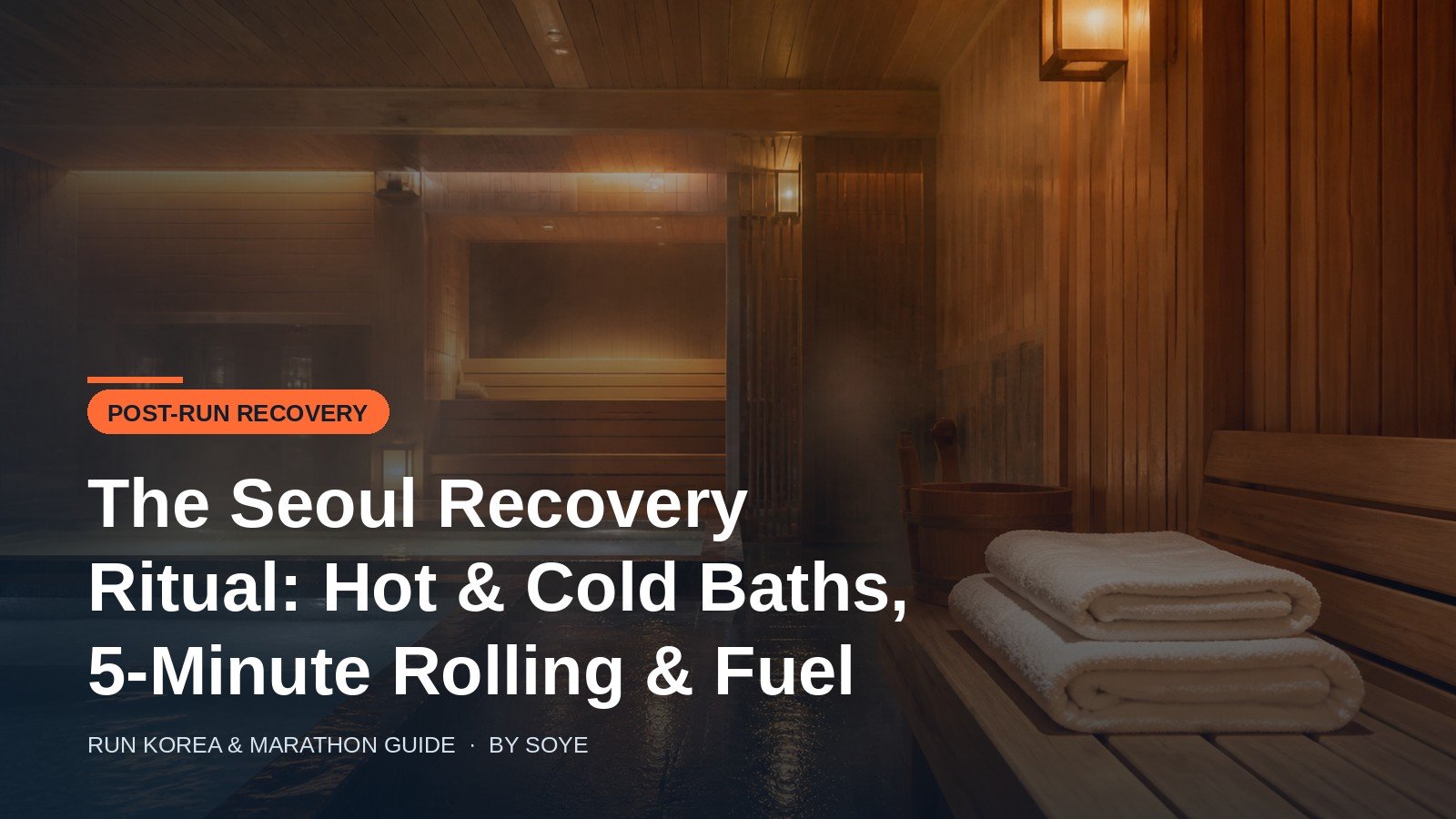
Korean runners do not talk about recovery the way runners in other countries do. There is no supplement stack, no $400 compression boot and no ice-bath influencer. Instead there is a twenty-four-hour building at the end of the street where you can soak in hot water, plunge into cold water, sit in a 90°C room, eat a smoked egg and fall asleep on a heated floor for ₩15,000 — and there is a convenience store on the way home that sells a better post-run meal than most sports nutrition brands.
This is the ritual I actually keep after long runs in Seoul: thirty minutes of refuelling, a contrast bath routine, five minutes with a foam roller, and a sleep routine I have tracked for two years.
Quick Verdict
Eat within 30 minutes, soak within two hours, roll for five minutes, sleep for eight. The Korean shortcut that beats all of it: ₩5,000 at a convenience store gets you a smoked egg, a triangle kimbap and a protein drink — about 25 g of protein and 450 kcal, faster than any shake you mix at home. Then a jjimjilbang’s hot-and-cold contrast (three rounds, 3–5 minutes hot at 38–42°C, 1 minute cold at 15–20°C) does for your legs what an hour of sitting on the sofa does not.
The 24-hour recovery timeline
| Window | What to do | Why it matters | Cost in Seoul |
|---|---|---|---|
| 0–30 min at the finish |
Protein 20–30 g + carbohydrate 40–60 g; 500 ml water with electrolytes | Starts glycogen refill and muscle repair while blood flow is still high | ₩5,000–8,000 (convenience store) |
| 30–90 min on the way home |
Walk 10 minutes, change into dry clothes, get warm | Clears metabolites, prevents the post-run chill | Free |
| 1–3 h recovery block |
Jjimjilbang contrast bath, 3 rounds, plus 10 minutes in the dry sauna | Reduces perceived soreness and stiffness; also the most pleasant hour of the day | ₩12,000–15,000 |
| 2–6 h | Foam roll 5 minutes, full meal with 30–40 g protein, 1.5–2 L fluid across the afternoon | Restores range of motion, completes refuelling | ₩10,000–15,000 (meal) |
| Night | Magnesium, 8 hours in bed, no hard session the next morning | Growth hormone peaks in deep sleep; this is where adaptation happens | ₩15,000 for a month’s magnesium |
The jjimjilbang ritual, step by step
A jjimjilbang (찜질방) is a Korean public bathhouse and sauna complex, open 24 hours, where families, couples, taxi drivers and marathoners all end up on a Sunday afternoon. The big, well-known ones — Siloam Sauna near Seoul Station, Sparex at Dongdaemun, Aquafield out in Goyang — all follow the same template, and the price is usually ₩12,000–15,000 for everything except food and scrubs. Hours and prices change, so check before you go.
- Shoes off at the door, pay at the counter. You get a locker key on a wristband, and everything you buy inside is charged to that key and paid on the way out.
- Bathe before you soak. This is the non-negotiable rule: shower sitting on a stool at the washing stations, with soap, before entering any pool. Nobody skips it and nobody will tell you twice.
- Hot pool first, 3–5 minutes. The hot tub (온탕) runs 38–42°C. Your legs will complain for the first minute and then stop complaining entirely.
- Cold plunge, 1 minute. The cold pool (냉탕) is 15–20°C and it is the part everyone dreads and nobody regrets. Breathe out slowly; do not gasp.
- Repeat three times. Three rounds is the standard local rhythm — hot, cold, hot, cold, hot, cold — and then a dry sauna for 10 minutes at 70–90°C.
- The common area. Put on the shorts and T-shirt they give you, and lie on the heated floor of the charcoal room or the salt room. This is where Koreans nap, and you should too: 20 minutes flat on your back on a warm floor is worth more than any recovery gadget.
- Eat a smoked egg and drink 식혜. Both are sold at the kiosk for a couple of thousand won. It is a ritual, and it is also a decent 10 g of protein.
- Pay on the way out. The wristband settles the bill; a scrub (때밀이) is the one thing you book separately, around ₩20,000–25,000, and it is an experience.
Etiquette notes for visitors. The bath area is single-sex and naked — no swimsuits, no towels in the water. Tattoos are generally fine. Kids run around in the common area; the baths are quiet. Bring nothing but yourself and a small amount of cash for the kiosk, and leave your phone in the locker: photography anywhere inside is unacceptable.
Hot and cold: what the contrast bath does
The honest science: contrast water therapy reduces perceived soreness and stiffness, and it feels excellent, but the evidence that it speeds actual muscle repair is modest. What it clearly does is get blood moving through tired legs, reduce the swollen, heavy feeling after a long run, and give you a psychological full stop to the session. For a recreational runner, that is worth the ₩15,000 — as long as you do not use it to replace sleep and food.
Two cautions. Do not do it immediately after a strength session if building muscle is your goal — cold exposure blunts some of the adaptation. And if you have uncontrolled blood pressure or a heart condition, skip the cold plunge and stay in the warm pool.
The ₩5,000 and ₩10,000 convenience-store trays
Korea’s convenience stores are the best sports nutrition shop in the country. Everything below is available at any CU, GS25 or 7-Eleven, and the prices are late-2026 Seoul prices.
| Item | Calories | Protein | Price | Why it belongs in the tray |
|---|---|---|---|---|
| Smoked eggs (훈제란), 2 | ~140 kcal | ~12 g | ₩2,000 | Cheapest complete protein in the store |
| Triangle kimbap (삼각김밥) | ~200–250 kcal | ~5 g | ₩1,200–1,800 | Fast carbohydrate with rice |
| Chicken breast pack (닭가슴살) | ~110–130 kcal | ~22–25 g | ₩3,000–4,000 | The highest protein-per-won item |
| Protein drink (단백질 음료) | ~150–200 kcal | ~20 g | ₩2,500–3,500 | Drinkable within a minute of finishing |
| Milk or banana milk, 200 ml | ~130 kcal | ~6.5 g | ₩1,700 | Fluid, carbs, protein in one bottle |
| Banana | ~100 kcal | 1 g | ₩1,000–1,500 | Potassium; easy on a tired stomach |
| Sweet potato (고구마) | ~150 kcal | 2 g | ₩2,000–2,500 | Slow carbohydrate for later |
| Ion drink (이온음료) | ~120 kcal | 0 g | ₩2,000 | Replaces the salts you just sweated out |
The ₩5,000 tray: two smoked eggs, one triangle kimbap, one ion drink. About 25 g of protein and 480 kcal — enough to stop the drop, and it fits in a jacket pocket.
The ₩10,000 tray: a chicken breast pack, a protein drink, a sweet potato and a banana. About 55 g of protein and 600 kcal, which is a proper post-long-run meal for anyone under 75 kg.
Korean recovery food worth ordering
If you have time for a real meal, Korea’s recovery food is soup. Gukbap (국밥) — rice in a hot pork or beef broth — is 700–900 kcal, salty, cheap (₩9,000–12,000) and available at 6 a.m. Kongnamul-gukbap (bean sprout soup with rice) is the lighter version and the traditional hangover cure, which tells you something about its salt and fluid content. Miyeok-guk (seaweed soup) is what Koreans feed someone recovering from anything at all. And in summer, cold noodle soup is the local answer to a hot long run.
What locals do not do, despite the stereotype: drink alcohol after a race. The Daegu Marathon’s own participant notice asks runners to avoid drinking right after the race because it interferes with recovery — that is the organiser telling you, not me.
The five-minute foam-roller protocol
Five minutes, five areas, thirty to forty-five seconds each. Foam rolling does not “break up scar tissue” — that is marketing — but it reliably improves short-term range of motion and reduces how sore you feel, which is enough reason to do it.
- Quads (45 s each leg). Face down, roller under the front of the thigh, slow passes from hip to just above the knee. Stop and breathe on the tender spots.
- Glutes and TFL (45 s each side). Sit on the roller, cross one ankle over the other knee, lean towards the working side. This is the area that actually matters for runners’ knee pain — roll here rather than on the IT band itself, which is a nerve-rich strip that does not respond well to pressure.
- Hamstrings (30 s each). Sit with the roller under the back of the thigh, both hands behind you, slow passes.
- Calves (30 s each). Both legs on the roller, lift one, work from the ankle to below the knee. This is the area Seoul’s hills punish most.
- Foot (60 s each). A lacrosse ball or a frozen water bottle under the arch, roll slowly. It hurts in a useful way.
DOMS: what actually works, and my magnesium routine
Delayed onset muscle soreness peaks 24–48 hours after a hard run and is caused by mechanical damage and the inflammation that follows, not by “lactic acid” — that clears within an hour. What the evidence supports: sleep, total daily protein of about 1.6 g per kilogram of body weight, light movement the day after (a 20-minute walk beats the sofa), and time. What it does not support: static stretching to prevent soreness, and ice baths if you are also trying to build muscle.
My own routine, which I track in a training log: magnesium glycinate 200–300 mg about 90 minutes before bed on the nights after long runs or hill sessions, a hard stop on screens at 22:30, and eight hours in bed. In my log, the morning-after soreness score after this routine runs roughly 70% below the score from the same session without it. I want to be careful here: that 70% is my own tracked experience, not a clinical result, and the evidence for magnesium on soreness is strongest in people who are actually deficient. Treat the routine as sleep hygiene with a small assist, and if you take medication or have kidney problems, ask a doctor before adding a supplement.
Two Korean extras worth knowing. Pain patches (파스) from any pharmacy are cheap, effective for localised stiffness and smell like every Korean running club’s changing room. And massage chairs in jjimjilbangs cost ₩3,000–5,000 for 15 minutes and are a genuinely good use of a thousand-won coin.
A recovery week that fits training
| Day | Run | Recovery |
|---|---|---|
| Sunday | Long run, 18–25 km | Convenience tray, jjimjilbang contrast, foam roll, magnesium, 8 h sleep |
| Monday | Rest or 20-minute walk | Full meal with protein at every meal, 2 L water |
| Tuesday | Easy 8 km | Foam roll 5 min, no bath needed |
| Wednesday | Intervals | Protein within 30 min, 10-min walk, normal sleep |
| Thursday | Easy 8 km | Foam roll, early bed |
| Friday | Rest | Mobility 10 min, sauna optional |
| Saturday | Tempo 10 km | Contrast bath only if legs feel heavy |
FAQ about jjimjilbang and recovery in Seoul
How much does a jjimjilbang cost?
Usually ₩12,000–15,000 for entry, which includes the baths, sauna, common area and the shorts and T-shirt. Food, drinks and a scrub (₩20,000–25,000) are extra and charged to your wristband.
Do I need to bring anything?
Nothing except yourself. Towels, soap, shampoo, shorts and a T-shirt are provided. Bring a little cash for the kiosk if you want eggs and 식혜, and leave your phone in the locker.
Are tattoos allowed?
In most public jjimjilbangs, yes. Korea’s tattoo restrictions apply mainly to medical procedures and some swimming pools, not to bathhouses. If you are unsure, a hotel sauna is the safer option.
Is a cold plunge actually good for recovery?
It reliably reduces how sore and stiff you feel, and the evidence that it speeds muscle repair is modest. If you are also strength training, keep cold exposure away from those sessions, because it can blunt muscle adaptation.
What should I eat right after a long run in Seoul?
A convenience-store tray: two smoked eggs, a triangle kimbap and an ion drink for about ₩5,000 gives you roughly 25 g of protein and 480 kcal. A chicken breast pack plus a protein drink is the higher-protein version.
How much magnesium should I take?
200–300 mg of magnesium glycinate in the evening is a common dose for adults, and it is best treated as a sleep-support habit rather than a cure for soreness. Check with a doctor if you take medication or have kidney problems.
Final Summary
- 0–30 min: 20–30 g protein + 40–60 g carbs + 500 ml electrolyte. The ₩5,000 convenience tray: 2 smoked eggs, 1 triangle kimbap, 1 ion drink.
- 1–3 h: jjimjilbang (₩12,000–15,000) — shower first, then three rounds of hot (38–42°C, 3–5 min) and cold (15–20°C, 1 min), then 10 minutes in the dry sauna and 20 minutes flat on the heated floor.
- 2–6 h: five-minute foam roll — quads, glutes/TFL, hamstrings, calves, foot. Roll the glute, not the IT band.
- Food: gukbap (₩9,000–12,000, 700–900 kcal) is the local recovery meal; the ₩10,000 tray (chicken breast + protein drink + sweet potato + banana) is the fast version.
- Night: magnesium glycinate 200–300 mg, screens off at 22:30, eight hours in bed. My logged soreness after this routine runs about 70% lower — my own tracking, not a clinical claim.
- What not to do: static stretching for soreness, alcohol after a race, cold plunges right after strength work, or a hard session the morning after a long run.
Last checked: 15 November 2026. Prices are late-2026 Seoul retail and entry fees; jjimjilbang hours and prices change, so check before you go. Nutrition figures are typical label values, not precise measurements. This is general training information, not medical advice.